
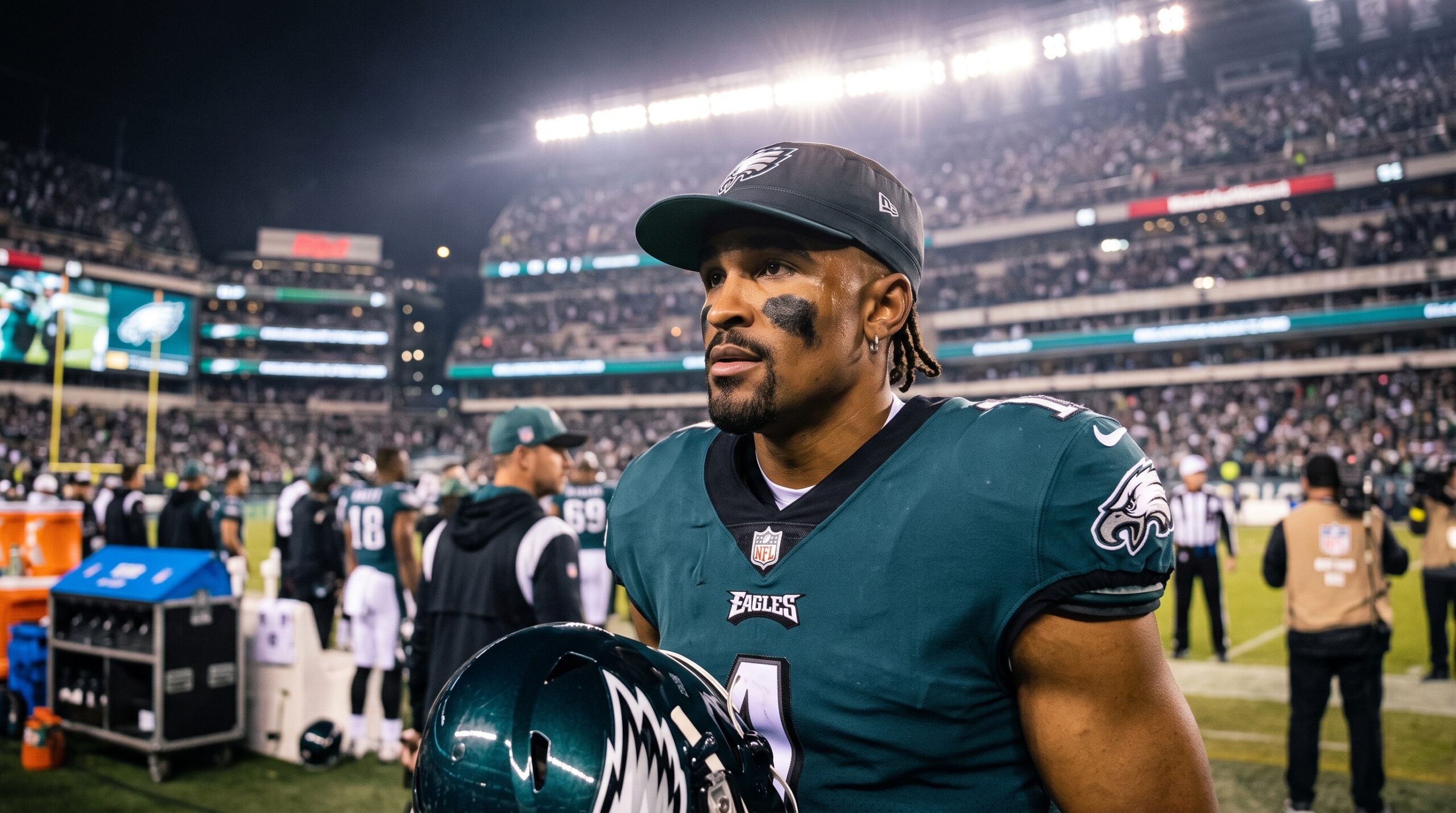
You build a roster around a franchise quarterback and then watch the foundation shift under your feet. That is the reality facing the Philadelphia Eagles right now. Jalen Hurts is out indefinitely with a superficial blood clot in his calf. He will miss Sunday’s game against the Carolina Panthers at minimum, and the timeline beyond that remains unclear.
This is not a typical soft-tissue issue. It is a medical situation that requires careful management, and it lands on a team already sliding through a difficult stretch. The Eagles have dropped three straight. Key skill players have missed time. Now their most important player is unavailable while doctors determine the next steps.
The news dropped Thursday after a follow-up ultrasound showed movement in the small clot. What looked manageable a week ago has become the latest complication in a season that refuses to stabilize.
How the Blood Clot Was Discovered
The timeline began on October 4 against the Los Angeles Rams. Hurts took a cleat to the calf during the game. He did not seek treatment right away. Four days later, after practice on October 8, he went to the training room and reported the issue for the first time.
He continued practicing fully while receiving treatment. The Eagles added him to the injury report. Then the team flew to London for the game against the Jacksonville Jaguars. Out of caution, doctors performed an ultrasound after the flight and walkthrough. It revealed a superficial blood clot.
Medical staff in London reviewed the results and cleared him to play. They emphasized that activity and mobility were important. Hurts played without limitation in the loss to Jacksonville. Doctors recommended a follow-up ultrasound within 72 hours of returning home.
That follow-up happened Wednesday night. The scan showed movement in the clot. The Eagles immediately ruled him out for the Panthers game and said they would determine the appropriate course of treatment. His health and safety are the priority.
What a Superficial Blood Clot Means
A superficial clot sits closer to the surface of the skin. It is generally less dangerous than a deep-vein thrombosis, but it still requires attention. Movement in the clot raised enough concern that the team shut Hurts down while they evaluate next steps.
Treatment options can include medication, monitoring, or further imaging. The length of absence depends on how the clot responds and whether doctors clear him for contact. Some athletes return relatively quickly. Others need more time. The Eagles have not provided a specific timetable beyond this weekend.
Ian Rapoport reported that Hurts will not return until the situation is fully resolved. That language suggests the team is taking a conservative approach, which is the only sensible one when dealing with clotting issues.
Tanner McKee Steps Into the Spotlight
With Hurts unavailable, Tanner McKee is expected to start against Carolina. The second-year quarterback has limited NFL experience but has prepared behind Hurts for two seasons. The offense will look different. McKee does not bring the same dual-threat dimension or improvisational ability that defines Hurts’ game.
The Eagles will likely lean on a more structured approach. Expect heavier use of the run game if Saquon Barkley is available, quicker throws, and fewer designed quarterback runs. McKee’s job is to manage the game, avoid negative plays, and give the defense a chance.
Backup quarterbacks have delivered before in Philadelphia. The organization knows the history. Still, asking a young player to stabilize a team that is already 2-3 and searching for answers is a tall order.
A Season Already Full of Setbacks
This injury does not exist in isolation. The Eagles have dealt with absences among key contributors throughout the early weeks. The offense has looked inconsistent. The three-game skid has raised questions about execution and scheme.
Losing Hurts removes the player who can create something out of nothing when protection breaks down or routes are covered. That improvisational element has been central to Philadelphia’s identity in recent seasons. Without it, the margin for error shrinks further.
The NFC East remains competitive. Falling further behind in the standings this early creates pressure that compounds quickly. Every remaining game carries heavier weight if the quarterback situation stays unsettled.
What Comes Next for Hurts and the Team
The immediate focus is treatment and monitoring. The Eagles will continue working with specialists to decide the best path forward. Follow-up imaging will likely dictate when he can resume football activities.
For the coaching staff the challenge is preparing McKee while keeping the rest of the roster locked in. Momentum is fragile. A win against Carolina would buy time and confidence. Another loss would deepen the sense that this season is slipping.
Players have spoken in the past about trusting the medical process. That trust will be tested in the coming days as the organization balances short-term competitiveness with long-term health for their franchise quarterback.
The Larger Picture for Philadelphia

Franchise quarterbacks are not easily replaced. Hurts has been the constant through both the highest highs and the recent struggles. His absence forces everyone else to raise their level at a moment when the team is already searching for answers.
The coming weeks will reveal how deep the roster is and how adaptable the scheme can be. They will also show whether the medical staff can resolve the clot situation cleanly enough for Hurts to return without lingering limitations.
For now the priority is clear. Get the clot under control. Protect the player. Then figure out how to win games in the meantime. That is the only order that makes sense when the alternative risks something far more serious than a lost Sunday.
The Eagles’ season just became more complicated. How they handle the next stretch will say a lot about where this group is headed.
FAQ
1. Why is Jalen Hurts missing the game against the Panthers?
A follow-up ultrasound on Wednesday night showed movement in a superficial blood clot in his calf. The Eagles ruled him out while determining the proper course of treatment.
2. How did the blood clot develop?
Hurts was cleated in the calf during the October 4 game against the Rams. He first sought treatment on October 8. An ultrasound in London before the Jaguars game revealed the clot, but doctors cleared him to play at the time.
3. Who will start at quarterback for the Eagles?
Tanner McKee is expected to start in Hurts’ place. The second-year quarterback has limited game experience but has prepared as the backup.
4. How long will Hurts be out?
The team has not given a specific timetable. He is out for Sunday at minimum and will not return until the medical situation is fully resolved.
5. Is a superficial blood clot serious?
It is generally less dangerous than a deep-vein clot, but movement in the clot prompted the Eagles to take a cautious approach. Treatment and further monitoring will determine the next steps.
Leave a Reply