
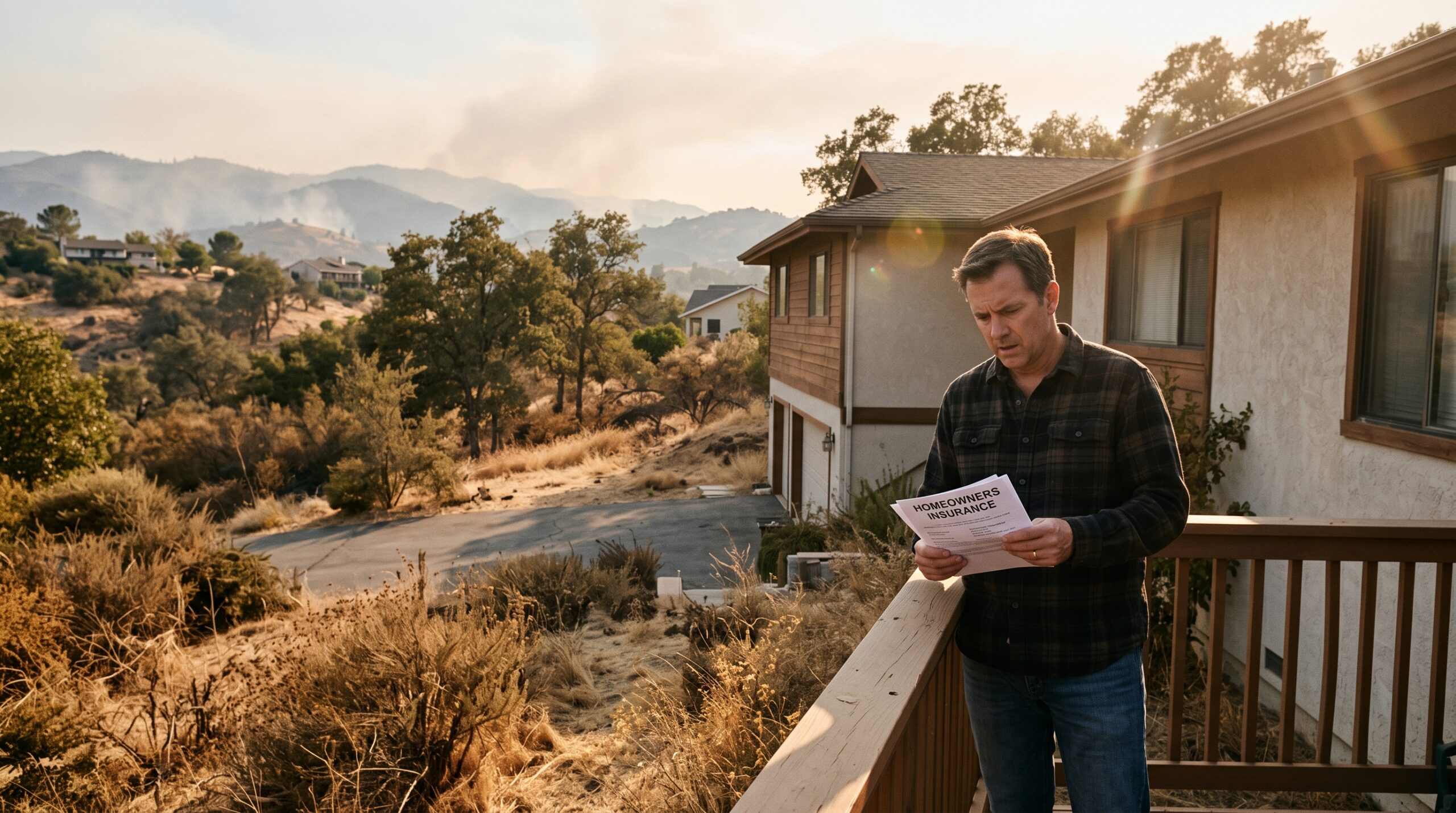
You open the renewal notice and the number hits harder than expected. Your California FAIR Plan premium is climbing. For many households the jump lands near or above 29 percent. Some wildfire-exposed homes will see the wildfire portion of the bill roughly double. The change took effect for new and renewing policies on October 15, 2026.
If you are one of the roughly 675,000 to 700,000 Californians relying on the state’s insurer of last resort, this is the moment to understand exactly what changed, why the increase is not uniform, and what options still exist. The California FAIR Plan rate increase is real. How much it costs you depends heavily on where your home sits and what you do before your next renewal.
This is not abstract policy talk. It is the largest approved FAIR Plan rate hike in recent history, and it arrives after years of private insurers pulling back from high-risk areas. Here is what homeowners insurance California residents on the FAIR Plan need to know right now.
What Exactly Changed on October 15, 2026
The California Department of Insurance approved an average 29.1 percent rate increase for FAIR Plan dwelling policies. The FAIR Plan had requested roughly 35.8 percent. Regulators trimmed it to 29.1 percent. The new rates apply to all new and renewal business with effective dates on or after October 15, 2026.
Nothing is automatically billed on that exact date for every policyholder. Your current rate stays in place until your policy renews. If your renewal falls in March 2027, you continue paying the old premium until then. Once the renewal arrives, the new pricing takes over.
The 29.1 percent figure is a statewide average. It is not a flat increase applied to every home. The largest share of the hike is tied to the wildfire component of the premium. Homes in significant wildfire risk zones will generally see higher increases. Some lower-risk urban properties may see smaller changes or even decreases.
Why the FAIR Plan Needed a Big Increase
The FAIR Plan exists as residual coverage for properties that cannot find insurance in the standard market. Enrollment has exploded in recent years as private carriers restricted writing in wildfire-prone areas. Policy counts climbed from around 140,000 a decade ago to nearly 700,000 residential and commercial policies by mid-2026. Total exposure reached hundreds of billions of dollars.
Major wildfire losses, including significant claims from the 2025 fire season, strained the plan’s finances. The rate filing was designed to bring premiums closer to the actual risk and cost of claims. This was also the first major FAIR Plan rate action reviewed under California’s Sustainable Insurance Strategy framework in some reports.
The result is higher prices for the residual market at the same time state officials are trying to encourage private carriers to return to more areas. That tension shapes the choices available to homeowners right now.
How Much More You Might Actually Pay
Because 29.1 percent is an average, individual outcomes vary widely. A homeowner currently paying $3,000 a year could see an increase of roughly $873 at the average rate, pushing the new premium near $3,873. Someone paying $5,000 could face an added $1,455. Those are illustrative statewide numbers only.
In high wildfire hazard areas the wildfire portion of the premium can rise much more sharply. Reports indicate some policyholders may see that component roughly double. Meanwhile, certain lower-risk properties could experience little change or a reduction. Your specific location, construction, mitigation features, and coverage limits all influence the final number.
Most FAIR Plan policies cover only basic perils: fire, lightning, smoke, and internal explosion. Liability, theft, water damage, and broader protection usually require a separate Difference in Conditions policy. That additional premium sits on top of the FAIR Plan bill and is not part of the 29.1 percent calculation.
What the FAIR Plan Covers and What It Leaves Out
Understanding the limits of FAIR Plan coverage is essential before you decide whether to stay or shop. The standard dwelling policy is narrow by design. It is not a full homeowners policy. Many households pair it with a Difference in Conditions policy from a private carrier to fill the gaps.
If your home is damaged by a covered fire, the FAIR Plan responds within its limits. Damage from other common causes often falls outside those limits. Review your declarations page carefully. Confirm what is and is not included so you are not surprised at claim time.
Practical Steps to Take Before Your Renewal
First, locate your exact renewal date. That single piece of information tells you how much time you have to act under the old rate.
Second, pull your current FAIR Plan declarations and any Difference in Conditions policy. Note the premium, coverage limits, deductibles, and any mitigation credits already applied.
Third, contact your agent or a broker who works the California market and ask whether any admitted carriers are now writing in your ZIP code under the Sustainable Insurance Strategy. Some private companies have begun expanding again in certain areas. Getting off the FAIR Plan and onto a full homeowners policy can restore broader coverage and, in some cases, produce a better overall price.
Fourth, examine home-hardening and mitigation options. Clearing vegetation, installing ember-resistant vents, upgrading roofs, and completing recognized wildfire preparedness programs can improve your risk profile. The FAIR Plan itself offers mitigation discounts that can reduce the wildfire portion of the premium. Private carriers often reward the same improvements.
Fifth, if you remain on the FAIR Plan, make sure your coverage limits still match your rebuilding costs. Construction prices have risen. Underinsurance is a separate risk that a rate increase can make more painful.
Why Some Homeowners May Still See Decreases
Not every policy moves upward. The rate revision redistributes cost according to risk. Properties with lower wildfire exposure can receive smaller increases or actual decreases as the plan adjusts pricing to better match expected losses. If you live in a denser urban or lower-hazard area and landed on the FAIR Plan during the broader market contraction, your renewal notice may look better than the headlines suggest. Still verify the numbers rather than assuming the average applies to you.
Looking Ahead: Market Conditions and Your Options

The California homeowners insurance market remains tight in many wildfire-exposed regions, yet it is not completely closed. State efforts to bring private capital back are producing gradual openings in some territories. That makes the period around your renewal a practical window to test the market rather than simply accepting the new FAIR Plan price.
Shopping does not require canceling your current coverage first. Obtain quotes while you still have active insurance. Compare total cost, coverage breadth, deductibles, and insurer financial strength. Factor in the cost of any Difference in Conditions policy if you stay on the FAIR Plan.
Homeowners who treat the rate change as a prompt to review the entire insurance picture often end up in a stronger position than those who wait until the renewal bill arrives with no alternatives in hand.
The 29.1 percent average California FAIR Plan rate increase is now live for new and renewing policies. Your personal impact depends on risk, location, and the steps you take between now and renewal. Check your date, review your coverage, explore private market options, and document any mitigation work that could improve your profile. The households that act with clear information tend to navigate the change with fewer surprises.
FAQ
When does the California FAIR Plan 29.1% rate increase take effect?
It applies to new and renewal dwelling policies with effective dates on or after October 15, 2026. Existing policies keep their current rate until they renew.
Will every FAIR Plan policyholder see a 29.1% increase?
No. 29.1% is a statewide average. High wildfire-risk properties generally face larger increases, sometimes with the wildfire premium component roughly doubling. Some lower-risk properties may see smaller changes or decreases.
Does the FAIR Plan provide full homeowners coverage?
No. It primarily covers fire, lightning, smoke, and internal explosion. Most policyholders need a separate Difference in Conditions policy for liability, theft, water damage, and other protections.
Can I switch from the FAIR Plan to a private homeowners policy?
Yes, if a private carrier is willing to write your property. Market conditions have begun to improve in some areas under California’s Sustainable Insurance Strategy. Ask a knowledgeable agent to check current availability in your ZIP code.
What can I do to lower my FAIR Plan premium or improve my options?
Complete recognized home-hardening and wildfire mitigation measures, ask about available FAIR Plan mitigation discounts, keep coverage limits current with rebuilding costs, and shop the private market before your renewal date.
Leave a Reply