
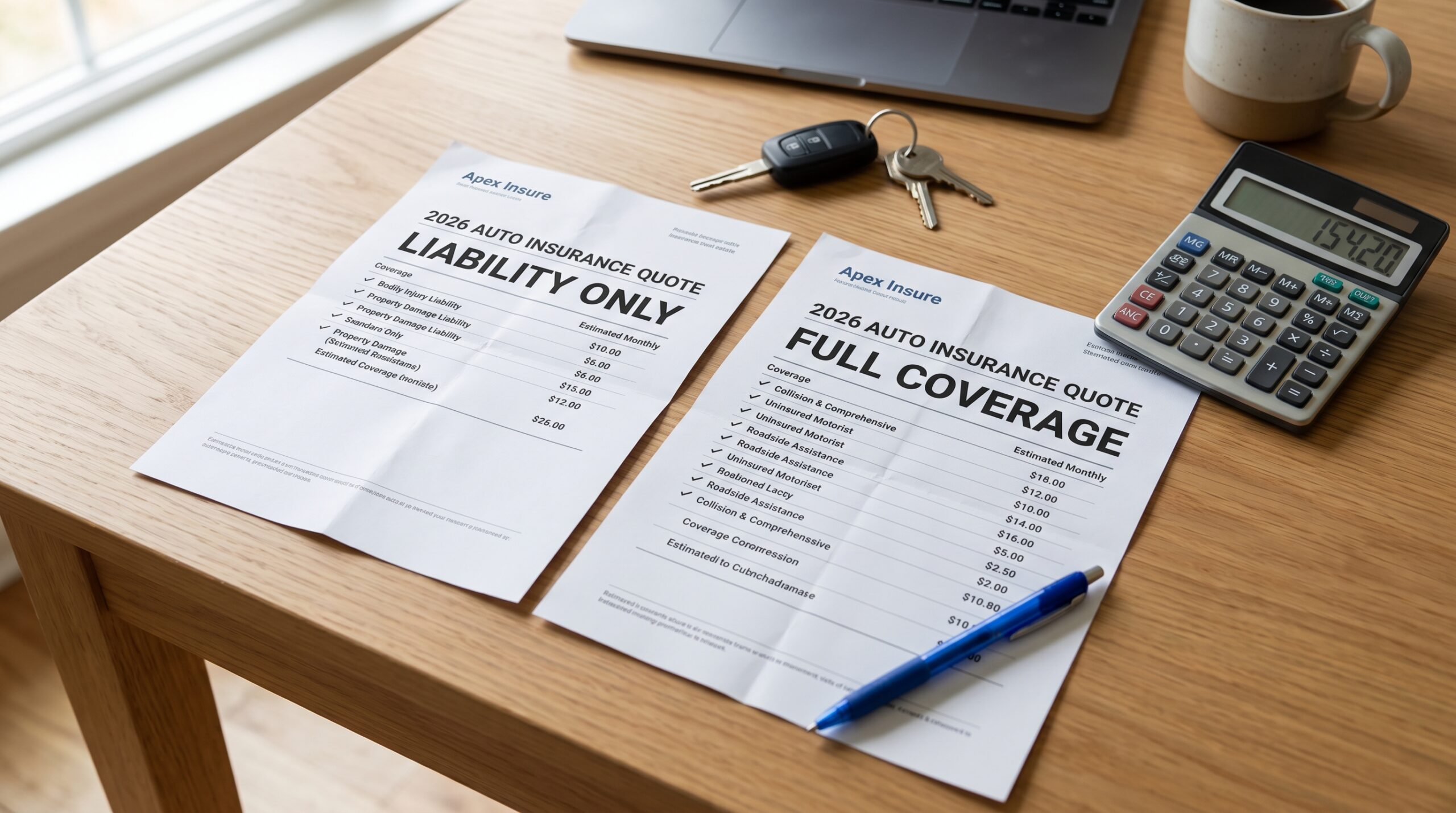
You open an insurance quote and see two very different prices—one for liability-only and one for full coverage—and wonder which you actually need. The gap can be hundreds of dollars a year. The right choice depends on what the law requires, whether your car is financed, how much the vehicle is worth, and how much risk you can absorb if it is damaged or stolen. Understanding the difference keeps you legal and helps you avoid paying for coverage that no longer makes sense—or dropping protection you still need.
What Liability Coverage Actually Pays For
Liability insurance covers damage and injuries you cause to other people and their property. Bodily injury liability pays medical costs, lost wages, and related damages for others hurt in an accident you cause. Property damage liability pays to repair or replace someone else’s vehicle or property. It does not pay to fix your own car, cover your own medical bills, or reimburse you if your vehicle is stolen. Nearly every state requires minimum liability limits to drive legally. New Hampshire is the main exception that does not mandate auto insurance, though financial-responsibility rules still apply after an accident.
What “Full Coverage” Usually Means
Full coverage is not a technical policy form. It is the common term for a package that includes liability plus collision and comprehensive coverage. Collision pays to repair or replace your vehicle after a crash with another vehicle or object, regardless of fault, subject to your deductible. Comprehensive covers non-crash events such as theft, vandalism, fire, hail, flood, or hitting an animal. Together they protect the value of your own car. Lenders and leasing companies almost always require collision and comprehensive while you still owe money on the vehicle.
State Minimums Versus Practical Limits
State minimum liability limits are often modest—commonly expressed as figures such as 25/50/25 ($25,000 bodily injury per person, $50,000 per accident, $25,000 property damage). Those amounts may not cover a serious injury claim or a newer vehicle you damage. Many advisors suggest higher limits, such as 100/300/100, if your assets or income could be exposed in a lawsuit. Raising liability limits usually costs less than adding collision and comprehensive, yet it provides meaningful protection against large third-party claims.
When Liability-Only Can Make Sense
Liability-only is most often appropriate when the car is owned free and clear, its market value is low, and you could afford to replace or repair it yourself if necessary. If the annual cost of collision and comprehensive approaches or exceeds the car’s value, the extra coverage may no longer be economical. Drivers who maintain an emergency fund specifically for vehicle loss sometimes choose this route. The decision still leaves you responsible for your own car’s damage in an at-fault crash or non-crash event.
When Full Coverage Is the Better Fit
Full coverage is typically required if you finance or lease the vehicle. Even when it is not required, it is often wise for newer or higher-value cars, or when you could not easily absorb the cost of a total loss. Comprehensive protection also matters if you live in an area with higher risks of theft, severe weather, or animal collisions. Hypothetical illustration: a driver owns a five-year-old car worth several thousand dollars and has no loan. After comparing quotes, the driver keeps solid liability limits and drops collision and comprehensive because the premium savings over a few years would exceed the car’s remaining value. Another driver with a newer financed vehicle keeps full coverage until the loan is paid and the car’s value has declined.
Other Coverages Worth Considering
Liability and full-coverage packages do not automatically include uninsured/underinsured motorist coverage, medical payments or personal injury protection, or roadside assistance. Some states require or strongly encourage uninsured motorist coverage. Medical payments or PIP can help with your own injuries regardless of fault. Review these options alongside the liability-versus-full-coverage decision so gaps do not appear at the worst time.
How to Decide in Practice

List the car’s approximate market value and whether a lender requires full coverage. Compare the annual cost of adding collision and comprehensive against that value and against your ability to pay for a major repair or replacement out of pocket. Check your state’s minimum liability limits and consider raising them if your assets are significant. Revisit the decision when the car ages, the loan is paid off, or your financial situation changes. Quotes from more than one insurer help you see the real price difference rather than relying on averages.
Liability coverage protects others from costs you cause and satisfies most state legal requirements. Full coverage adds collision and comprehensive so your own vehicle is protected against crashes and many non-crash events. You need at least the liability your state requires; you need full coverage if a lender demands it or if the car’s value and your finances make self-insuring the vehicle too risky. Match the coverage to the car’s value, the loan status, and your risk tolerance, and adjust as those factors change. Review your declarations page, get fresh quotes, and choose the combination that keeps you legal and financially resilient rather than simply the cheapest option on the screen.
FAQ
Is liability insurance required?
Yes in nearly every state. New Hampshire does not require auto insurance but has financial-responsibility rules after an accident.
Does full coverage pay for my car?
Full coverage typically includes collision and comprehensive, which pay for damage to your own vehicle subject to deductibles and policy terms.
When can I drop collision and comprehensive?
Often when the car is paid off and its value is low enough that the premium is no longer worth the protection, provided you can handle a loss yourself.
Are state minimum liability limits enough?
They meet the legal requirement but may be too low for a serious injury or property claim. Higher limits are often recommended if you have assets to protect.
Does full coverage include uninsured motorist or medical payments?
Not automatically. Those are separate coverages you may add depending on your state and needs.
Leave a Reply