
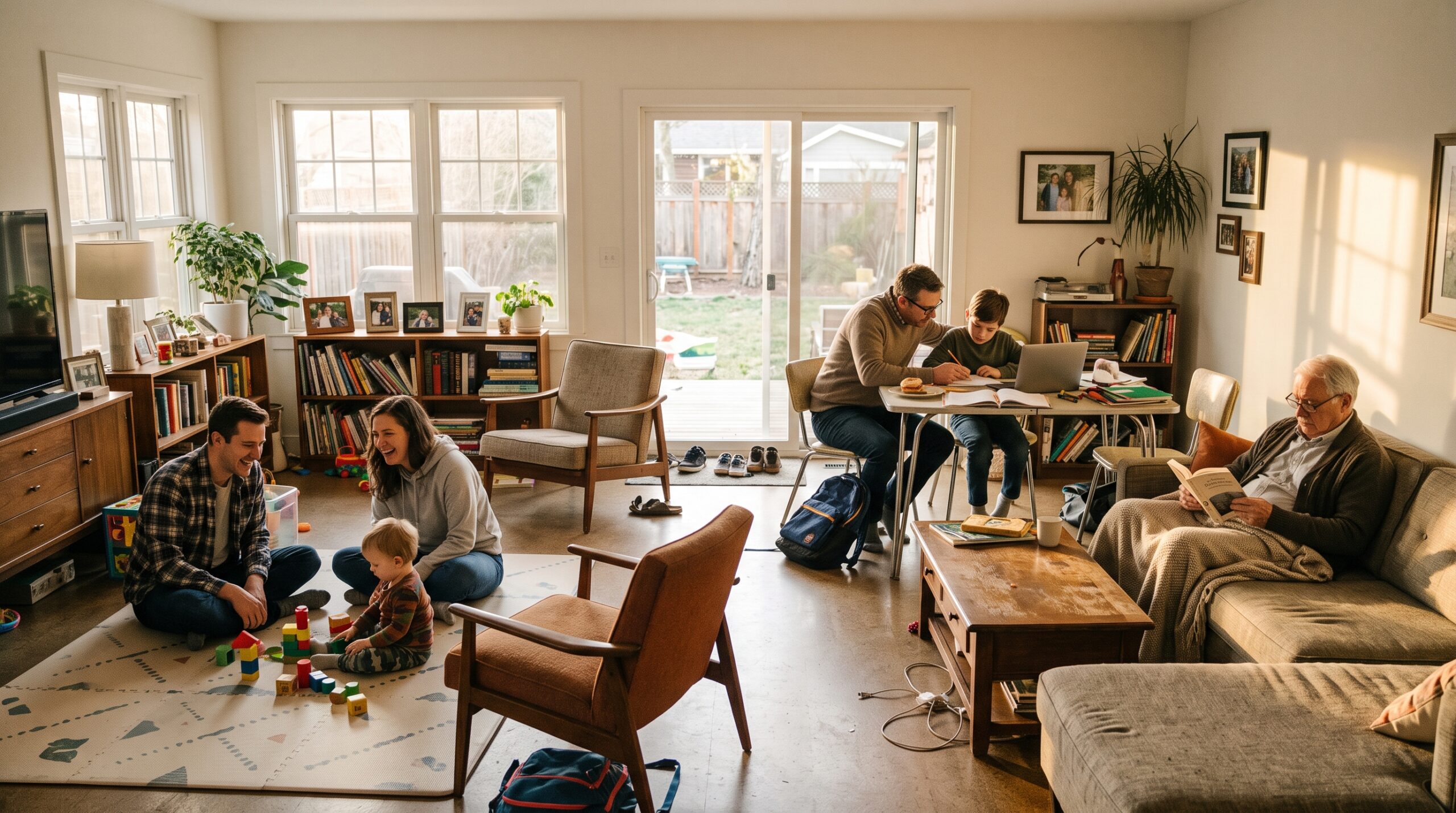
You look around at the families you know and something feels different. The image of two parents, a couple of kids, and a picket fence that once filled every textbook and sitcom no longer matches most of the households you actually encounter. Friends are living with parents well into their thirties. Cousins are raising kids with a best friend instead of a spouse. Neighborhoods in some cities have almost no married couples with children while suburbs nearby look almost traditional. The change is real, measurable, and happening faster than many of us expected.
This is not a moral lecture or a nostalgia trip. It is a clear-eyed look at American family trends based on the latest Census data, Pew Research, and Institute for Family Studies reports from 2025 and 2026. Primary keyword focus stays on American family trends. Secondary angles include marriage deserts, multigenerational households, dual-income parenting, single-parent families, later marriage ages, and rising cohabitation. The goal is practical understanding so you can make better decisions about your own relationships, housing, and support systems.
The Decline of the Married-Couple Household
In 1975 nearly two-thirds of American households were married couples. By 2025 that figure had fallen to 47 percent. The share of married-couple households with their own children under 18 dropped even more sharply, from 54 percent to about 37 percent. One-person households rose from 20 percent to 29 percent over the same period.
These numbers come straight from the Census Bureau’s Current Population Survey. They do not mean marriage has disappeared. They mean it is no longer the default living arrangement for most adults. Median age at first marriage now sits at 30.8 for men and 28.4 for women. Fifty years ago those ages were 23.5 and 21.1. People wait longer, and a larger share never marry at all.
If you are in your twenties or thirties and feel pressure about “settling down,” the data shows you are part of a broad cultural shift rather than a personal failure. The practical consequence is that fewer households have two adult earners by default, which changes everything from housing affordability to retirement planning.
Marriage Deserts and the Urban-Suburban Divide
Recent mapping by the Institute for Family Studies reveals sharp geographic differences. In parts of Detroit the share of householders ages 15 to 64 who are married falls as low as 13 percent. Eastern Cleveland and nearby areas sit at 18 percent for households with children headed by married couples. Eastern Washington, D.C., and central Milwaukee show similar patterns, with fewer than one in four child households led by a married couple.
Contrast that with high-marriage areas such as parts of Fort Bend County, Texas, or Utah County, where married householders can reach 79 percent and married-parent households approach 90 percent. The divide is not random. It tracks with education levels, employment stability, and local social norms. Urban cores with higher concentrations of poverty and lower marriage rates create what researchers call marriage deserts. Suburban and certain rural zones remain marriage gardens.
For anyone deciding where to raise children or build community, these maps matter. The density of two-parent households in a neighborhood correlates with school outcomes, crime rates, and available informal support. Choosing a place is no longer just about schools and commute times. It is also about the prevailing family structure.
Multigenerational Households Keep Growing
Nearly 22 percent of the U.S. population lived in multigenerational households according to the most recent Pew analysis of American Community Survey data. That share has climbed steadily since the 1970s, when it hovered around 13 percent. Real estate data from 2024 and 2025 shows four million owner-occupied homes containing at least three generations under one roof.
Financial pressure drives much of the rise. Young adults face high housing costs and student debt. Older adults face rising care needs and longer lifespans. Cultural preferences among Hispanic and Asian American families also play a role. The practical upside is shared childcare, shared mortgage payments, and reduced isolation for older relatives. The downside includes privacy trade-offs and potential conflict over household rules.
If you are considering moving in with parents or adult children, treat it like a business decision. Put expectations in writing. Discuss money, chores, guests, and exit plans before the boxes are unpacked. Many families who succeed at this arrangement report it works best when everyone has some private space, even if that space is only a bedroom with a lock.
Dual-Income Parenting Has Become the Majority Pattern
Among different-sex couples with children under 18, 52 percent now have two full-time working parents. That figure is up from 46 percent a decade earlier and more than double the 31 percent recorded in 1975. The classic arrangement of a full-time working father and a non-employed mother has fallen from 42 percent to 23 percent.
Education level shapes the pattern. Nearly 70 percent of mothers with postgraduate degrees who live with a partner are in dual full-time households. Racial differences also appear. Black mothers in partnered households are more likely to be dual full-time earners than White or Asian mothers.
Parents in these arrangements report both gains and strain. Many say the extra income reduces financial stress. Many also say the schedule leaves little margin for illness, school events, or simple recovery time. Single working parents face an even tighter squeeze. Fourteen percent of working parents are neither married nor living with a partner.
Actionable step for dual-income households: build explicit backup systems. Identify two people who can cover school pickup or a sick day without major disruption. Treat that network as infrastructure rather than a last-minute favor.
Single-Parent Families and the Stability of Children’s Living Arrangements
About 21 percent of children under 18 lived with a single parent in 2025, the large majority with their mothers. The overall distribution of children’s family structures has been relatively stable since 2019. Roughly 65 percent live with two biological parents, most of them married. Ten percent live in stepfamilies. The rest are distributed across other arrangements.
Stability at the national level does not erase variation by race, income, and geography. Children in single-parent homes face higher average risks of economic hardship and certain developmental challenges. At the same time, many single parents build strong support networks and raise thriving children. The data simply shows elevated average risk, not destiny.
For single parents the practical priorities remain consistent: reliable childcare, stable housing, and consistent adult relationships for the children. Policy debates often focus on child support enforcement and earned income tax credits. At the individual level, the highest leverage moves are often local: finding a school with strong after-school programs, joining parent networks, and protecting sleep and mental bandwidth.
Cohabitation, Later Marriage, and New Family Experiments
Seventy-seven percent of Americans ages 38 to 43 have lived with an unmarried romantic partner at some point. Nearly 80 percent of adults under 30 view cohabitation as acceptable even without marriage plans. Forty percent of children are born to unmarried parents. The median age of first marriage continues to climb.
Alongside these trends, some younger adults are experimenting with platonic co-parenting arrangements. Couples or groups of friends intentionally raise children together without romantic relationships. These setups remain a small share of total families, but they reflect a broader willingness to redesign the household around childcare needs rather than romantic partnership alone.
Fertility rates sit below replacement. Forty-four percent of non-parents ages 18 to 49 say they are unlikely to have children. The reasons mix economic calculation, cultural change, and personal preference. For those who do want children, the later start often means fewer total years of parenting and greater reliance on technology or extended family support.
What These American Family Trends Mean for Your Decisions

The shift away from the mid-century nuclear model is not temporary. Married-couple households are a minority. Multigenerational living is rising. Dual full-time work is the majority pattern among partnered parents. Urban marriage deserts and suburban marriage gardens create different opportunity structures for children.
You cannot reverse national trends with personal choices alone. You can respond intelligently to the environment those trends create. If marriage and children matter to you, the data suggests treating relationship formation with more intentionality and earlier planning than previous generations required. If you prefer other arrangements, build the practical supports those arrangements need: clear agreements, shared resources, and realistic expectations about time and money.
Housing choices, career timing, and community selection all interact with family structure. A neighborhood with high rates of two-parent households offers different informal safety nets than one dominated by single-adult or multigenerational homes. Dual-income couples need different childcare strategies than single parents. Multigenerational households need different floor plans and conflict-resolution habits.
The families that adapt best treat structure as a design problem rather than a moral scorecard. They look at the actual constraints they face and build systems that fit those constraints. That approach works whether the household contains one adult or four generations.
Keep watching the data. The Census and research institutes will release updated numbers every year. Use them to adjust your plans rather than to judge anyone else’s. The American family is not disappearing. It is rearranging itself. Your job is to arrange your own piece of it so it supports the life you actually want.
FAQ
What is the current share of married-couple households in the United States?
According to 2025 Census data, 47 percent of households are married couples, down from 66 percent in 1975.
Why are some cities called marriage deserts?
In certain urban neighborhoods the share of households with children headed by married couples falls below 25 percent, and in extreme cases below 15 percent. Researchers use the term to highlight the geographic concentration of low marriage rates.
How common are multigenerational households now?
About 22 percent of the U.S. population lives in a household with three or more generations, a steady rise from 13 percent in 1970.
Are most parents in dual full-time work arrangements?
Yes. Among different-sex couples with children under 18, 52 percent have two full-time working parents as of 2025.
What is the median age at first marriage today?
Men marry for the first time at a median age of 30.8 and women at 28.4, according to the latest Census figures.
Leave a Reply